Friday, April 28, 2017

Tape Measures Don't Work

Each child is so important to us as educators.
We want them to have the world at his/her fingertips.
He/She is one of "our kids" and will always be.
As an educator, I have spent hundreds upon hundreds of hours working with students and teachers problem solving why a particular student is demonstrating struggles in particular disciplines. We sit in our classrooms reviewing copious notes, accessing resources, and problem solve next possible solutions on how to help the student determine the right strategy for success. Without real time during the day to conduct this work, this is a before school, after school, or late evening task for our students. We do this not because of a paycheck or even an accountability metric--we do this because students succeeding is the right thing to do. It's called integrity.

Yet, we struggle is a society on why we can't just get kids to be "at the bar". It should be easy as making a quick adjustment. Hold the phone! We need to remember, our children are not products that are built and shipped for purchase. My parents own a local sheet metal manufacturing company, and I spent a summer working in quality assurance. I would review parts fabricated, review specifications, and ensure accuracy. If the product was off by even an eighth of an inch we could make an adjustment in the process and verify the new product. Then, we could mass produce.

Kids are not mass production. We can't take out a tape measure, check the blueprints, and adjust. It is not just that simple--anyone who thinks different should spend a day with a teacher. We make broad-stroke comments about how to 'fix' education, get kids 'up to speed', and earn that school-wide letter grade of an "A" for recognition. Yet, we do not truly understand the world of a teacher in the classroom.

While you are watching your favorite TV show (maybe Scandal, Designated Survivor, or the Bachelor), just remember the teacher who lives next door or has your child or grandchild in his/her classroom, is combing over his/her notes on the child who lives across the street and just can't seem to master reading fiction texts or adding fractions with unlike denominators. As we enter Teacher Appreciation Week, take time to say thank you to that neighbor, family member, child's teacher, or other educator you know. They need our support, our appreciation, and our cheerleading.

Thank you to Chase's and Carson's teachers. You mean the world to us.

Tuesday, April 18, 2017

Why Inside Out?

I'm convinced education is more important today than ever more. It is also more scrutinized that ever in the history of education [#mythought]. Whether it's politics, social media, lack of where else to blame--and we have to blame someone--it's there. Each of us have to take a hard look at oneself, and ask am I creating that scrutiny? It's time to look inside out.

I knew since I was seven I was going to be a teacher. Could it be from an awesome teacher like Mrs. Schwartz who just showed me that you can solve the impossible when we look at problems different? Or maybe it was in fourth grade when I finally was 'old' enough to be in Little Hoosiers to help with the straw maze at our local festival? Or, maybe it was high school journalism when Mr. Smekens selected me as editor of the yearbook because he saw something in me that I wanted to find in others?

Interestingly, those brief memories have little to do with standardized testing, school choice, poverty, behaviors, parental involvement, title one, special education, ESSA, NCLB, and any other great 'yeah but" you may pull out in an effort to measure my experience. A great education is only measured by the individual who receives it. The job of a great education is up to everyone and no one all at the same time. It's quite a conundrum.   [#newfavewordtouse].

I am not naïve or simple minded. I'm a thirty-something, white man with a doctorate. I'm the privileged by many who would argue. I don't discount that, but nor does that discount my own beliefs and experiences. We have an obligation to guarantee a viable, accessible learning experience for each and every child. I firmly believe we have very few educators who wake up and say, "I'm going to make life a living hell for my students today." Or, do we have very few students who wake up and say, "I want to cause my teacher eternal grief today so their future children will not have my name." But, yet, we believe both to be true. Why?

Do you want to know about your community's education system? Then, go find out. Volunteer. Spend time in a classroom. Watch a teacher for a day -- guarantee that job isn't easy. But, yet, we find ways to simplify education. We give schools a rating system. We take all of the work of each educator in a school setting, and surmise the planning, teaching, reflecting, parenting, guiding, mentoring, facilitating, and connecting down to a single letter grade, number, or some other attribute.

Here's what I know in my 30+ years in this wonderful life I've been given: My passion lies in creating outstanding school cultures to help build amazing learning environments for students, changing the world to be a better place than I found it, and loving to inspire others through learning. You can't get that out of a test score.

Drummond is the Director of Professional Learning for the International Center for Leadership in Education (ICLE) | A division of Houghton Mifflin Harcourt. His posts are solely his views and represent no other educator. You can follow Drummond at @adamddrummond on Twitter and follow ICLE @RigorRelevance using #leadered.

Saturday, July 12, 2014

Put On Your Networking Shoes

If I had to pick one attribute the conferences provides me each year, it’s this: Networking! We all are attending this conference together at this precise moment in time. Yet, we all got here differently. Reflect back to your own professional networking footprints as I share how I arrived Sunday for the conference!

I presented with a colleague in 2009 at the Indiana Coalition of Quality Schools conference. During my presentation, I shared with participants about the organizational transformation of our school. In the audience, was an educator who knew. Dr. Nancy Phenis-Bourke. At that time, Dr. Bourke provided professional development opportunities to a network of administrators in central Indiana. Nancy asked me to speak at that event.

While I was at the event, Nancy encouraged me to explore professional opportunities through NAESP, specifically the Principal Mentorship program. During the mentor institute and certification process, I worked closely with NAESP Zone Director Missie Paschke and NAESP Kathleen Sciarappa, as well as a cohort of administrators from around the state. The end result provided me with fantastic knowledge and resources to support other principals, and connections with NAESP and information to connect with my own state membership (in which I was a member but did not realize the benefit. I quickly did.

I connected with IASP Executive Director Dr. Todd Bess and became involved on the board of directors for IASP through my own district. Through my involvement in IASP, I have found other educators who are passionate about helping children succeed, building teacher knowledge, and advocating for education in my state.

The opportunity to network grew with my recent role as the NAESP State Representative for Indiana and serving as a trainer for the NAESP mentor program. My networking footprint isn’t about the names or the titles or the roles in which I serve. The networking footprint is about how these experiences helped craft my own leadership skills as a principal. I would tell you—and the teachers at Lincoln would agree—I don’t have all the answers. But, when I have a question, I have a wealth of resources with whom I can connect.

Who is part of your professional networking footprint? Want to take that next step? Make it happen at #NAESP14!


Sunday, July 14, 2013

Eric Jensen's Take On Creating Opportunity for Students


“When teachers focus on what matters most, good things happen,” says Eric Jensen.
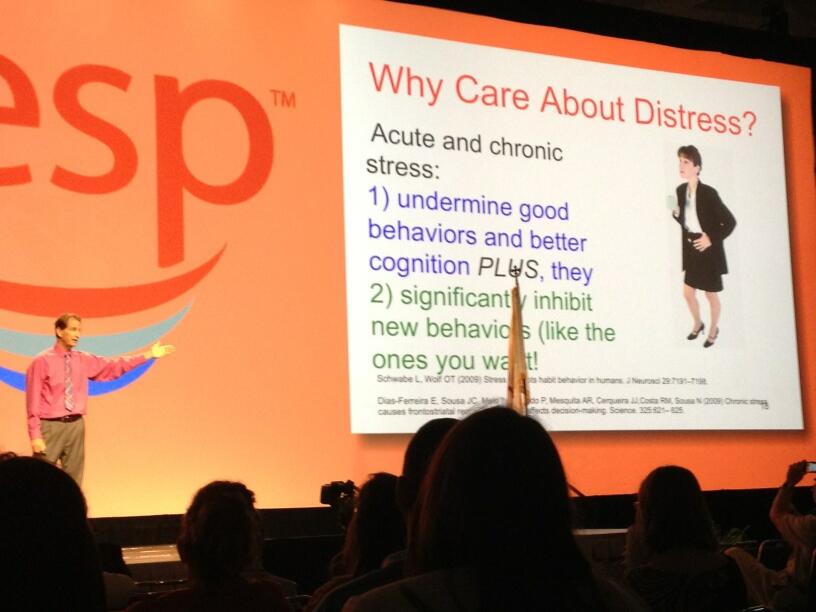
So, what matters most? Jensen explored that in his plenary session, “Teaching With Poverty in Mind.” In just seventy minutes, he generated more wonder and excitement for conference attendees than a trip to Neverland with Peter Pan might. Finding the answers to alleviating poverty’s impact, though, isn’t as simple as heading three stars to the right and straight on ‘till morning. Nonetheless, Jensen provided four key facts and strategies that educators can take to support all students with an environment of support, acceptance, and excellence.
Fact #1: Teachers can change the structure of the brain in just five days.
Neurogenesis is the brain’s production of new cells. The brain is so much more plastic than scientists previously thought. But factors such as distress, inactivity, boredom, and depression can suppress neurogenesis. Educators can maximize students’ neurogenesis with exciting, multi-faceted classroom activities, and by getting students moving—research has found that the hippocampus creates new neurons after exercise.
  • School Strategy: Never keep kids in at recess. One minute of new activity doesn’t produce new neurons, but 20 minutes does.
Fact #2: Five years in a row of great teaching can erase the effects of poverty on students.
Great teaching is about more than just instruction—classroom climate ranks in the top ten contributors to student achievement. Relationships between teachers and students can decrease distress in students. The well-known adage, “Kids don’t care how much you know until they know how much you care” rings true.
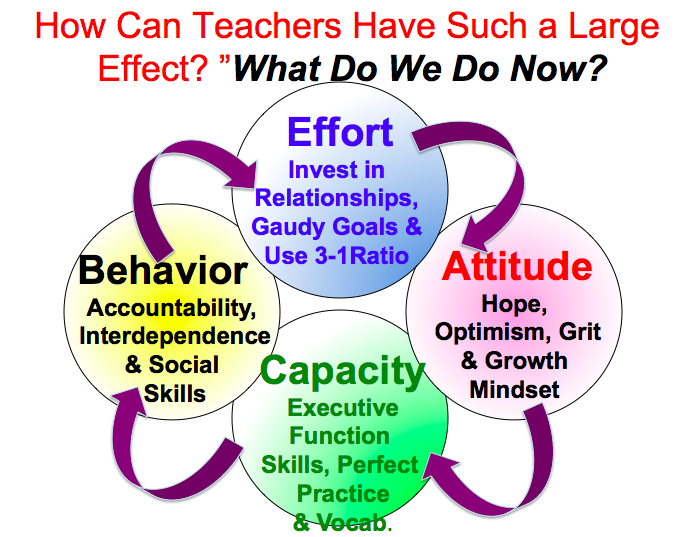
  • School Strategy: Introduce teachers to Jensen’s BASE: Behavior, Attitude, Capacity, Effort system. (See graphic.)
Fact #3: We must demand excellence. Period.
It doesn’t get much clearer than that. Jensen emphasizes that creating excellence and high expectations is a good thing. When high expectations aren’t reached, the result still places you higher than where you would be if you settled for mediocrity. When you have high expectations, your students rise to them. Jensen shared an example of an all-boys high school with at-risk students that has sent 100 percent of its graduates to college three years running. So, don’t give excuses. Four-year-olds can point fingers; you can only look in the mirror.
  • School Strategy: Jensen gives six steps to High Achieving Schools:
  1. Set nearly impossible “gaudy goals.”
  2. Foster collaboration and trust. Without these qualities in your school, you can’t reach excellence.
  3. Connect the dots between data, behavior, and learning on a daily basis.
  4. Build the BASE (see above).
  5. Cultivate good culture by taking responsibility rather than pointing fingers and using feedback from colleagues and administration.
  6. Manage yourself as a leader.
Fact #4: Empathy, optimism, and patience must be taught.
Fun fact: Brain research indicates that our minds are wired for just six emotions: sadness, joy, disgust, anger, surprise, and fear. In order to create emotionally and cognitively sound students, we must teach humility, forgiveness, empathy, optimism, compassion, sympathy, patience, shame, cooperation, and gratitude. We wrongly assume our students already know or exhibit these emotions. We must be specific in not only teaching, but recognizing these emotions in our students. 
  • School Strategy: Develop a plan that works for your school to ensure that teaching of emotions occurs daily and routinely. One place to start: Prohibit sarcasm. Oh, and give compliments—3 compliments a day is a good place to start.
Next Steps
Jensen left attendees with three simple steps to making a change at your school: ABC, or Agree, Buy-In, and Commit. Agree on a strategy, generate buy-in with your team, and commit to a plan.
Learn more about these facts and strategies in Jensen’s PowerPoint presentation:Jensenlearning.com/NAESP2013#
Dr. Adam D. Drummond is a Director of Professional Learning at the International Center for Leadership in Education.

Copyright © National Association of Elementary School Principals. No part of the articles in NAESP magazines, newsletters, or Web site may be reproduced in any medium without the permission of the National Association of Elementary School Principals. For more information, view NAESP's reprint policy.


Full article origination: https://www.naesp.org/2013-conference-news-online-friday-july-12/focusing-what-matters-four-facts-and-strategies-eric-jens

Saturday, July 13, 2013

Exploring the Components of Brain-Compatible Classrooms


EXPLORING THE COMPONENTS OF BRAIN-COMPATIBLE CLASSROOMS

By Adam Drummond
Attendees of David Sousa’s session, “The Basics of Creating Brain-Compatible Classrooms” learned the importance of a certain four-letter word.  
(No, not that kind of four-letter word.)
It’s TALK. Turns out, Sousa revealed, too much teacher-talk and not enough student-talk is one way classrooms can be not brain-compatible.
Sousa, author of over a dozen books on brain science and education, shared tips on how to use talking in a way that’s more brain-friendly for students. He also explored other tactics in his two-hour workshop, including basic brain functions (or SET), “feet and seat,” and humor.  
Talk
Teachers work way too hard today, Sousa said. Nearly 80 percent of high school classroom time is spent with a teacher talking. Elementary classrooms are a tad better, with 50 percent of classroom time devoted to teacher talk. Yet, research tells us that students who process information, collaborate, and talk through problems are more likely to move information from short-term to long-term memory. Additionally, talk helps us focus.
Administrators can help curve this percentage by modeling less talk time during staff meetings.
SET
Your brain has three main areas:
  • the survival region, or your brain stem;
  • the “emotional detector,” or limbic area; and
  • the thinking executive function system, or frontal lobe.
Remember these three basic functions as survival, emotions, and thinking, or SET.
Here’s the kicker, though: the limbic system matures, on average, between ages 10 and 12, but the thinking region (the frontal lobe) is not fully mature until the age 22 to 24.
Keep this in mind when working with students, and do yourself a favor: Never ask a student, “Why did you do that?” after they make a poor choice. More than likely, they don’t know.
Feet and Seat
After sitting for 20 minutes, according to conference keynote speaker Freeman Hrabowski, we lose focus. Sousa told us why. The blood from our body has pooled to our feet and our seat.
Blood needs to circulate to keep the brain engaged. Have students stand, walk, move, or do something. This simple break can refocus students for the next task. Do this for yourself, too! If you are at your office desk for over twenty minutes, your mind is not at your sharpest.
Humor
Laughing releases hormones called endorphins, which are good. Cortisol, another hormone, is released when stress enters the body. Chemically speaking, your body thrives much better on endorphins. So, simply put: create opportunities for laughter, fun, and enjoyment.
Here’s a bonus: our brains love novelty. So, dress up as a character, and you will have both—novelty and laughter.
In closing, Sousa provided educators with an easy to implement framework for brain-compatible classrooms. The ideas above—using movement, humor, and the right kind of talking—are simple, easy ways to create classrooms that allow collaboration, fun, and understanding in learning about the brain.                      
Education is the only profession that has the ability to change humans every day. We transform the brain and alter its thinking and emotions through our interactions and plans that we provide our students. Each day is a new day to make a difference. Be the change.
Oh, two more things Sousa taught attendees: Humans cannot effectively multitask. And research has yet to show that technology has changed attention spans of our students—believe it or not, it’s true! 
Adam Drummond is principal of Lincoln Elementary School in Huntington, Indiana.
https://www.naesp.org/2013-conference-news-online-thursday-july-11/exploring-components-brain-compatible-classrooms

Friday, July 12, 2013

Monkey See, Monkey Do: Modeling Behavior's to Elicit Best Practice

Today was a great day (and it is only 10:20 am). I presented the first session of the day at NAESP, and it was focused administrators on how to model and use instructional strategies to create a culture that they desire. The best part of being in education is we all grow continuously. I found new ideas from colleagues visiting me today. Lifelong learning is fantastic. Attached is a link to the five-minute podcast about the session. I plan to share more when I am back at the hotel this evening. Off to learn more!

Wednesday, July 10, 2013

A Little Fear is Healthy

Have you watched the Halle Berry movie "The Call"? Don't! You won't sleep and my fear-o-meter is in overdrive. My children may never leave the house again. So, the fear level may be a little out of sorts from the movie, but a little fear of trying something new can be healthy. Educational leader Todd Whitaker write sin his book, "Leading School Change" (2010) that change is inevitable, but growth is optional. This phrase that he adopted as his mantra made me pause and reflect. Change always occur, but fear often allows us to make excuses to grow in that change. In order to grow from change, we must be willing to take the fear and use it to our advantage. Think top of roller coaster fear and not being kidnapped-"The Call" fear.

As educators, our job is so important. Molding young lives, creating a safe place, and moving them along to ensure academic readiness by set standards that have been Pre-determined by some entity. But, we do have control of what that change looks like. Even, if a school had a set schedule (pot calling kettle black). In order to try something new-accept change-it's easy when you think of these few things to help. 

1.Admit you don't know it all. It's okay to jump in and try something without all the answers. At some point you just have to try it. Otherwise we plan to plan the execution of the plan that never comes to fruition.  Set your timeline to try and follow through.

2. Say Your Sorry. What? You bet. I was teaching a group of high school students in Atlanta about GMOs (not sure what they are-look it up-I have your curiosity buzzing). In the midst of the turn and talk, I realized the content I just delivered was inaccurate. So, a simple regroup and an I'm sorry was all it took. They chuckled and said, "We knew what you meant Mr. Adam."  One girl followed up with, "No teacher has ever apologized to us before." Ouch. Really? Come on-we are all human. It's okay for kids to see that. 

3. Think you need help-get it! There is no shame in asking for help or consultation. Why coypu think our President has a cabinet? We don't know it all. So don't fake it. Ask for input, feedback, and clarification. I speak for many administrators when I tell you that we'd rather you (the teacher) come and say help than try to fake it. 

4. Make a goal.  Decide what that goal is. Write in on a sticky note or put in on your desktop of your computer. Make that goal happen. You will feel better. 

Change will occur. What will you do? Don't be fearful. Be brave. Consider the four ideas above and give it a whirl. The downhill on the roller-coaster is thrilling. But you can't experience that without the climb up to the peak of it. 

It’s Time to Say Goodbye to Final Exams

As we embark as parents with a high school freshmen, we have had many adjustments. No adjustment has been more difficult than the...